
A person can know how an algorithm works, recognise a pattern in a dataset, or generate an answer with AI and still struggle to decide what to do with that information. In P/CVE, where decisions are shaped by social contexts, human behaviour, and competing interpretations, knowing more does not automatically mean understanding better.
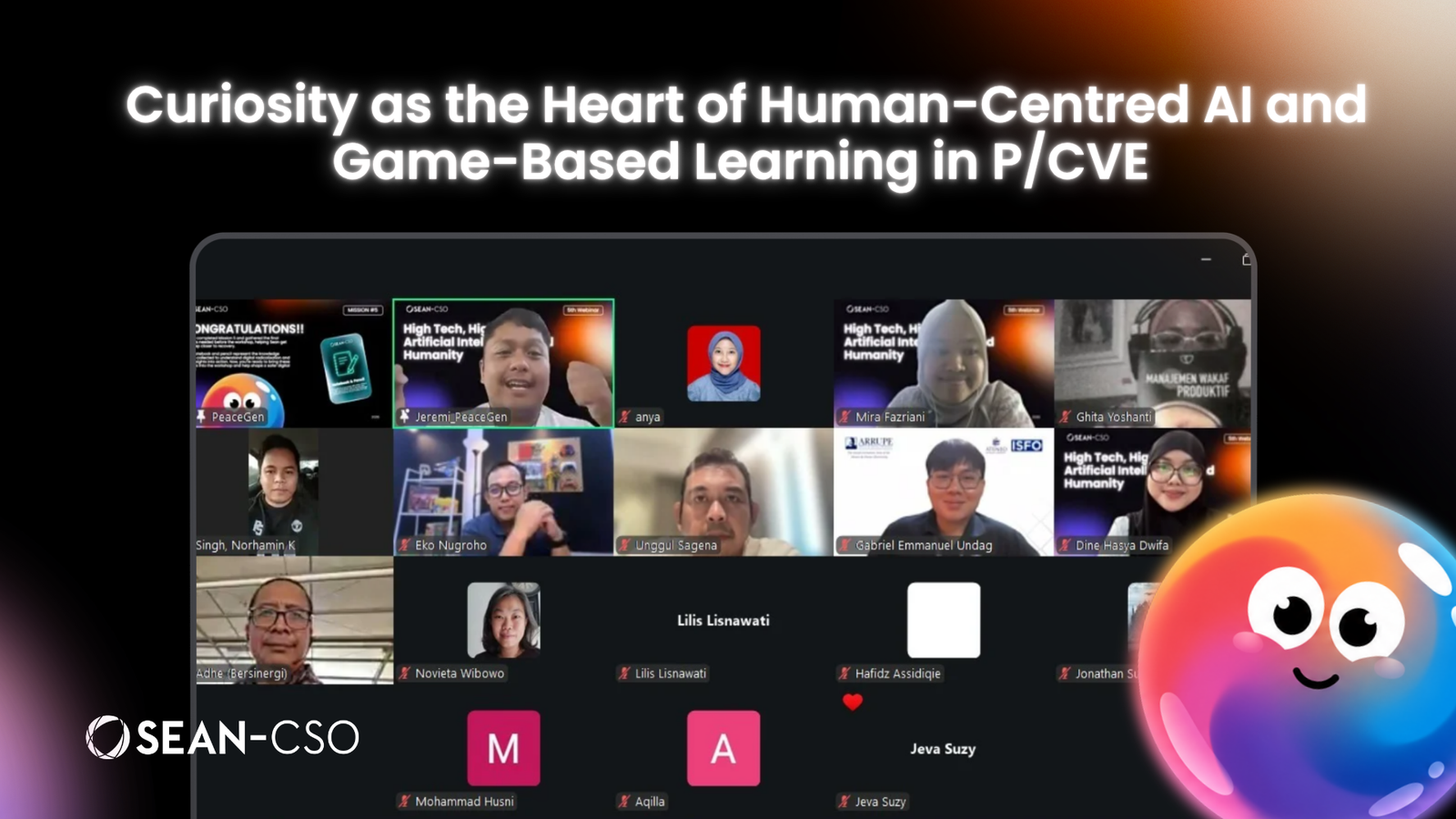
The question, then, is how people learn to make sense of what they know. At the final SEAN-CSO 2026 webinar, held on 13 October 2026 under the theme High Tech, High Touch: Artificial Intelligence and Humanity, Eko Nugroho, CEO of Kummara, explored the role of curiosity and game-based learning in making AI use more human-centred. His session considered not only what technology can help people accomplish, but also how people can remain active, thoughtful participants in the learning process.
Curiosity Beyond the Answers AI Provides
AI can introduce people to ideas they might not have considered, help organise information, and offer alternative perspectives. Yet, as Eko emphasised, AI provides another perspective rather than a solution in itself. What matters is how people interpret that perspective and decide what to do with it.
This is where curiosity becomes essential. Rather than treating critical thinking as a skill that can be developed independently, Eko highlighted curiosity as part of what makes us human. It encourages people to look beyond an immediate answer, ask further questions, and examine whether an explanation holds up to scrutiny.
For P/CVE practitioners, this distinction has practical implications. AI may help explore information or identify patterns, but the meaning of those findings depends on the context in which they emerge. An output cannot replace the judgement required to understand communities, assess risks, or determine an appropriate response. Curiosity keeps practitioners involved in that process instead of allowing a convenient answer to become the final word.
Why Games Matter in the Learning Process
Curiosity becomes more meaningful when people have opportunities to act on it. Game-based learning (GBL) provides one way to create those opportunities. In this approach, games serve as the primary medium for structured learning activities, allowing participants to explore problems, make decisions, and learn from the outcomes. A facilitator can further guide reflection and connect the experience to its learning objectives.
Games are not simply a way to make learning entertaining. Their value lies in creating situations where people can experiment with ideas and experience the consequences of their choices. Simulations, in particular, allow participants to engage with complex scenarios without having to encounter the same circumstances in real life. People do not need to experience an actual war, for example, to begin exploring the decisions and challenges associated with conflict.
Eko illustrated this approach through cas[e]cade, a simulation set in a fictional Southeast Asia in 2028. In this scenario, extremist networks exploit accelerating digitalisation to spread AI-based disinformation and synthetic media. Participants take on the role of an Elite Strategic Task Force under the SEAN-CSO Alliance, tasked with integrating ethical AI literacy, game-based community resilience, and cross-border early warning systems.
The scenario asks participants to consider how these elements interact rather than approach each challenge in isolation. They must assess the situation, weigh possible responses, and make decisions despite uncertainty. This creates space to practise the kind of thinking P/CVE work demands, where responses often depend on context and where a single answer rarely captures the whole problem.
Putting AI to Work Without Losing Human Judgement
Curiosity and experiential learning also shape how practitioners can use AI in their everyday work. Eko introduced the 3R Framework for AI Optimisation: Reframe, Rethink, and Refine. Reframe involves finding, developing, and organising ideas more clearly. Rethink encourages users to gather information, enrich their perspectives, analyse data, and challenge assumptions. Refine focuses on testing, updating, and improving ideas through iteration.
The framework treats AI use as an ongoing process rather than a shortcut to a finished product. Practitioners still need to define the problem, evaluate the information they receive, and decide whether the results are useful. Eko demonstrated how a carefully designed prompt could help analyse a book’s central arguments and counter-intuitive insights, illustrating how AI can support research and the development of learning activities.
Eko also encouraged P/CVE practitioners not to feel ashamed of using AI. Instead, they should learn how the technology works, experiment with its possibilities, and reconsider how it might support their practice. The challenge is to bridge the gap between knowing what AI can do and applying it meaningfully. This requires making the technology accessible, helping people understand its benefits, and giving them opportunities to test it in relevant contexts.
Keeping the Human at the Centre
AI and game-based learning serve different purposes, but both can contribute to more active and thoughtful learning. AI can help people explore information and alternative perspectives, while games give them opportunities to test ideas and practise decisions through experience. Curiosity connects these approaches by encouraging people to question, investigate, and remain engaged in the process.
For P/CVE practitioners, the objective is not to adopt technology simply because it is available. It is to understand where these tools can contribute, where human judgement remains essential, and how learning can prepare people to respond to complex challenges. Used with intention, AI and games can expand the possibilities for learning without displacing the people at its centre.
The final SEAN-CSO 2026 webinar returned to a question that extends beyond technology itself, “What makes learning meaningful?” Access to information matters, but so does the willingness to question it, learn through experience, and consider perspectives beyond one’s own. Curiosity helps sustain that willingness. In P/CVE, where understanding people is central to the work, keeping curiosity alive is part of keeping learning human.

SEAN-CSO provides a platform for civil society organisations in Southeast Asia to network and share resources. Through this network, members can support each other, share knowledge, and coordinate efforts to address the region’s social challenges. In doing so, SEAN-CSO contributes to strengthening the voice of civil society at both regional and international levels.