
A counter-narrative does not begin when the message is published. Long before a video reaches an audience or a campaign appears on social media, there is a more fundamental question: “How well do we understand the people and narratives we are trying to reach?”
The message itself is only one part of the work. Practitioners also need to understand their audiences, test different approaches, and look closely at how people respond. These steps can reveal what works, what does not, and what may need to change. AI is beginning to enter this process, not simply as a way to create content, but as a tool for research, engagement, and evaluation.
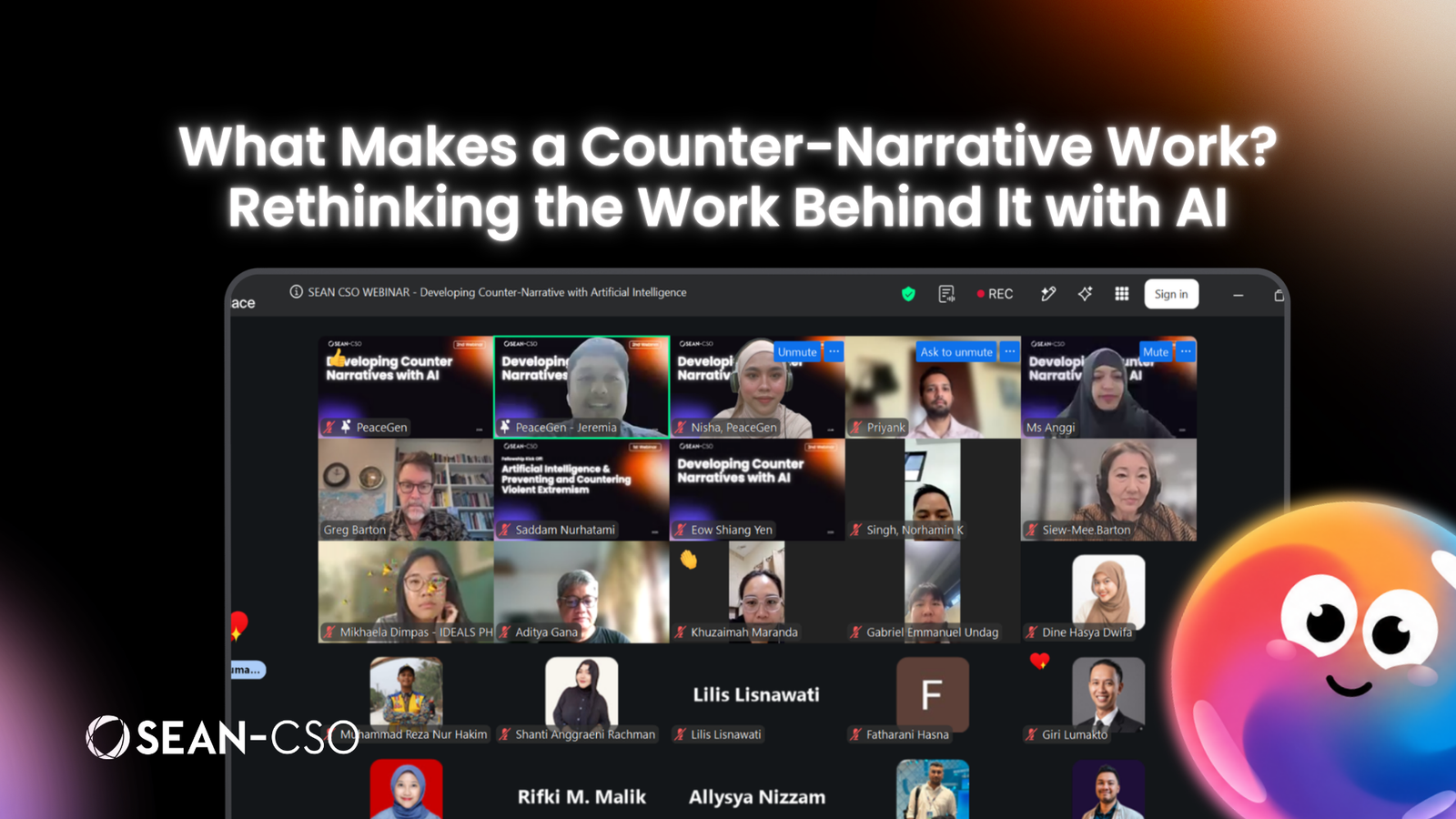
These ideas came into focus during the second webinar of the SEAN-CSO 2026 learning series, Developing Counter-Narratives with AI, held online via Zoom on 22 September 2026. Bringing together around 20–35 participants, the session featured Priyank Mathur, Founder and CEO of Mythos Labs. His work spans counter-terrorism, communications, cybersecurity, and the use of technology to address violent extremism and other technology-facilitated harms. The discussion looked beyond the message itself to explore where AI could support the work happening before, during, and after a counter-narrative reaches its audience.
Counter-Narratives Begin Before the Message
Counter-narratives are often understood as messages designed to challenge harmful narratives, but developing one involves more than creating persuasive content. Practitioners need to understand the narratives they are responding to, the people encountering them, and the environments in which those narratives develop, while also testing and evaluating whether an intervention produces meaningful responses.
This broader approach to counter-narratives also opens up different possibilities for using AI. During the webinar, Priyank shared three examples: ALDOUS, AI-powered exercises and simulations, and predictive modelling. Each illustrates a different way AI can support P/CVE practitioners, whether in rehabilitation and engagement, testing interventions, or analysing responses.
AI-Supported Rehabilitation Through ALDOUS
One of the main examples discussed was ALDOUS, a generative AI-powered system developed by Mythos Labs. The organisation describes ALDOUS as a tool designed to support counter-terrorism efforts, including risk assessment, de-radicalisation, rehabilitation, and reintegration. Mythos Labs combines AI development with human subject-matter expertise, reflecting the broader idea that technology can strengthen P/CVE work without removing practitioners from the process.
In the rehabilitation context discussed during the webinar, ALDOUS can engage with users conversationally, communicate in their own language, and remain available around the clock. It can maintain continuity across interactions while providing information related to potential risk levels, possible drivers of radicalisation, unmet needs, and potential de-escalation pathways. Rather than functioning as a replacement for rehabilitation practitioners, the tool is intended to provide additional information and support for their work.
The discussion also highlighted the importance of reaching individuals where they already are. ALDOUS can be introduced through click-to-message campaigns on social platforms, while local CSOs and practitioners remain involved in monitoring, interpreting, and adapting its use. This local involvement matters because approaches to rehabilitation cannot simply be transferred from one setting to another without considering differences in language, culture, social conditions, and the factors that shape radicalisation and disengagement.
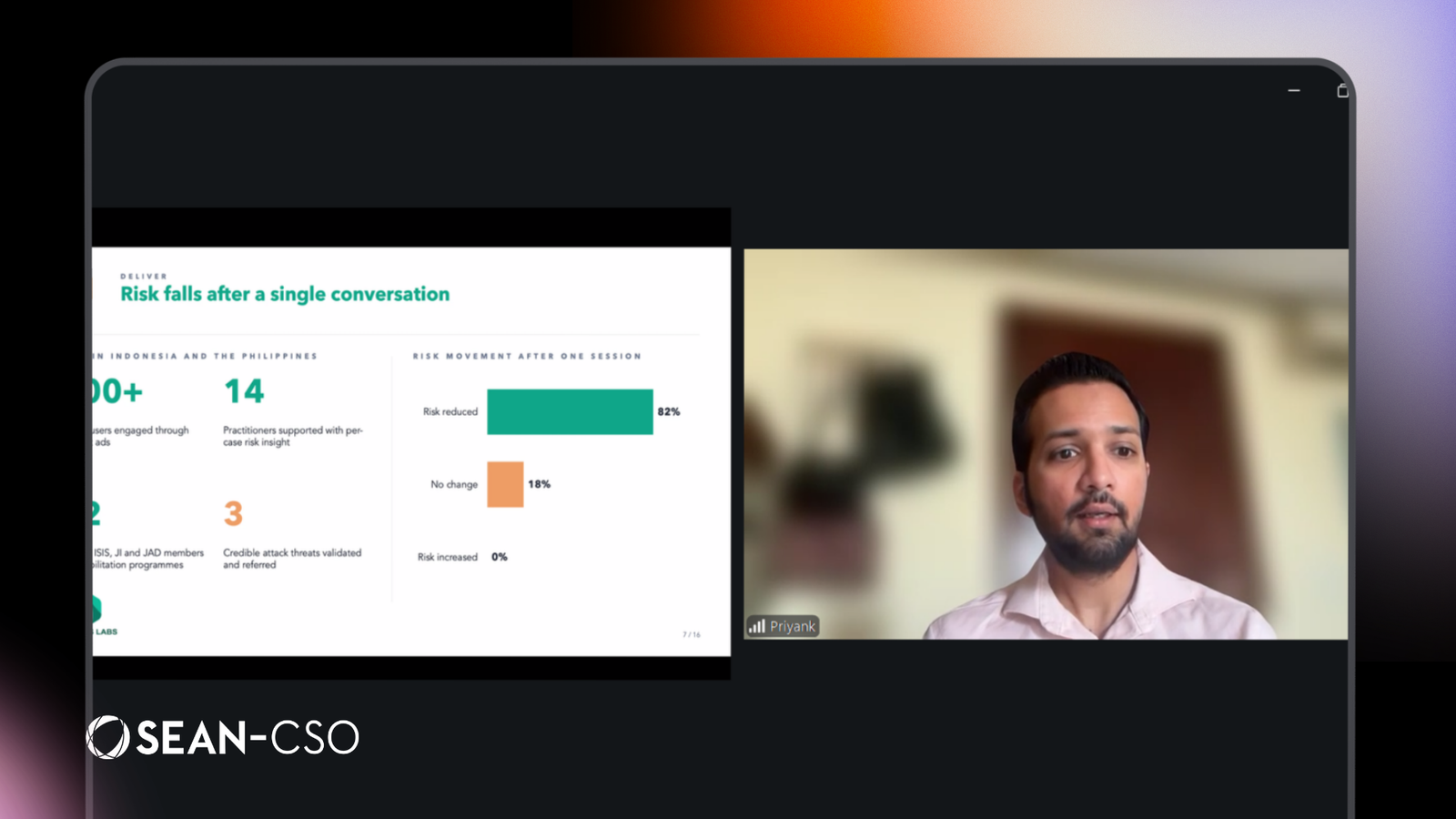
Priyank shared an approximately 82% reduction in risk among users who engaged with ALDOUS, while noting that more detailed findings and outcome data are still being developed. The discussion also touched on its use in Indonesia, where around 14 individuals involved in rehabilitation had engaged with the tool at the time of the webinar. Some former terrorists in Indonesia and the Philippines were also described as willing and eager to engage with the chatbot, pointing to the potential for conversational AI to create an additional channel for engagement within rehabilitation efforts.
Testing Counter-Narratives Beyond Scripts
The webinar then moved from engaging with individuals to exploring how AI could help practitioners test their interventions. Traditional exercises often rely on predetermined scenarios, while AI-powered simulations can create more open-ended interactions by responding dynamically to what participants say.
These interactions can provide additional information about how people respond to different narratives or situations. AI can help process multiple interactions and identify patterns, giving practitioners another layer of evidence when refining an intervention. Mythos Labs similarly describes its AI-powered table-top exercises as adaptive simulations designed to test responses to different real-world threats and scenarios.
Predictive modelling offers another way to examine responses. One example discussed involved showing participants a counter-narrative video while recording their reactions in real time, after which AI could help analyse those responses. Emotional reactions may provide useful information for evaluation, although interpreting them still requires human and contextual understanding because an observable response does not automatically explain why someone reacted in a particular way.
Understanding Before Predicting
Participants also asked whether AI could help anticipate emerging harmful narratives and support the development of peaceful alternatives earlier. Priyank highlighted that forecasting remains difficult and that practitioners first need to understand how harmful narratives develop organically and identify the patterns behind their emergence.
The discussion also addressed data privacy and research access. Publicly available information from projects such as these can focus on anonymised findings, allowing insights to be shared while protecting the identities and sensitive information of individuals involved. For P/CVE practitioners, this balance becomes especially important when working with information about individuals who may be at risk or involved in rehabilitation.
Questions about whether ALDOUS could eventually be integrated into general-purpose platforms such as GPT, Gemini, or Claude also brought the issue of purpose and safeguards into focus. As discussed during the webinar, there are currently no plans for direct integration into these platforms, with the project continuing to rely on funding and collaboration with local CSOs. The concern is not simply whether a tool can be made widely available, but whether broader access would always be appropriate for the contexts and users involved.
Keeping People at the Centre
Across these different applications, the webinar returned to the role of human practitioners. AI can support research, rehabilitation, simulations, and analysis, but it does not replace the contextual knowledge and judgement required to interpret information and decide how an intervention should be used.
For P/CVE work in Southeast Asia, this also means involving local practitioners who understand the languages, communities, grievances, and environments in which interventions operate. AI can expand what practitioners are able to process and test, but its usefulness depends on having clear purposes, appropriate safeguards, and people who can assess whether its outputs make sense in a particular context.
The conversation will continue in the third webinar, Detecting Extremist Narratives Using AI, on 29 September 2026, from 1:30–3:30 PM WIB (GMT+7). The next session will shift the focus from developing counter-narratives to exploring how extremist narratives can be identified and analysed with the support of AI.
Continue the conversation!
https://seancso.org/registerseancso2026

SEAN-CSO provides a platform for civil society organisations in Southeast Asia to network and share resources. Through this network, members can support each other, share knowledge, and coordinate efforts to address the region’s social challenges. In doing so, SEAN-CSO contributes to strengthening the voice of civil society at both regional and international levels.