
The digital space is constantly changing. New platforms emerge, online communities shift, and the ways people encounter and engage with information continue to evolve. For P/CVE practitioners, these changes create a moving landscape where responding to emerging challenges requires not only understanding what is happening online, but also finding practical ways to support their work.
Throughout the SEAN-CSO 2026 webinar series, we have explored different ways technology can support P/CVE. We looked at how AI can support counter-narrative development and how AI-assisted tools can help researchers detect and analyse extremist narratives. The fourth webinar takes the conversation into a more practical direction by exploring how AI can support practitioners in making decisions and developing simple tools for their PCVE projects.
The Digital Space Is Part of the Picture
Digital radicalisation does not happen through content alone, as narratives exist within wider digital environments shaped by platforms, communities, interactions, and the ways information travels between them. People can encounter narratives through different pathways, whether while searching for information, interacting with online communities, following particular accounts, or encountering content through platform recommendations. The same narrative can also take different forms as it moves across platforms and communities, making it important for researchers and practitioners to understand not only what is happening online but also how these patterns may affect their work.
Understanding these patterns and trends can require practitioners to work with different types of information, identify what may be relevant, and consider what these insights could mean for their next steps. This is where practical applications of AI can become useful, as practitioners can look beyond using AI to detect or analyse content and consider how it could also support the processes that follow, including decision-making and project development.
Mapping a Moving Landscape
One of the challenges is that the digital landscape itself keeps moving, with platforms introducing new features, users moving between online spaces, and communities forming and changing over time. The ways people communicate also continue to develop through short-form videos, memes, private or semi-private groups, and other emerging forms of digital communication, meaning that the patterns researchers observe today may not look exactly the same tomorrow.
For P/CVE practitioners, keeping up with these changes is therefore not simply about following the latest technology, but also about finding ways to work with changing information and respond to emerging needs within their projects. AI may offer one way to support this process by helping practitioners organise information, explore different possibilities, or simplify certain tasks that would otherwise require considerable time and effort, although its value ultimately depends on how well it responds to an actual problem or need.
Instead of asking only “What can AI do?”, practitioners can also consider “What part of my work could AI help me do better?” This shift can help place AI within the context of practical P/CVE work rather than treating the technology as the starting point itself.
AI in a Changing Digital Landscape
AI adds another layer to this changing landscape. As we explored in the previous webinars, AI can help researchers process large amounts of information, identify patterns, and examine online narratives at a scale that would be difficult to manage manually, while these capabilities can also support practitioners as they work with information and consider what actions may be relevant to their projects.
Imagine having to work through a large collection of documents, notes, or other project materials before making a decision. AI could help organise information, summarise key points, or structure materials in ways that make them easier to work with, giving practitioners additional support as they navigate information that may otherwise take significant time to process.
However, using AI for decision-making does not mean handing decisions over to AI, because an AI system can help process information or present possible options while practitioners still need to assess the context, question the outputs, and determine what is appropriate for their specific situation. In P/CVE work, where decisions can involve people, communities, and sensitive contexts, human judgement therefore remains essential, with AI serving as a support rather than a replacement for practitioners’ expertise.
AI Assistance and Simple Tools
AI can also be used for more than generating responses or analysing information, as practitioners can begin developing simple tools that respond to specific needs within their work. A tool could help organise information, support a particular workflow, simplify a repetitive task, or make project activities easier to manage without necessarily requiring practitioners to build a complex application or have an advanced technical background.
The starting point can instead be a practical problem that practitioners already encounter in their work, followed by an exploration of whether AI can help turn a potential solution into something usable. A practitioner might identify a task that requires repeatedly organising information, reviewing materials, or following a particular process, and then explore whether an AI-supported tool could make that process simpler and more manageable.
This approach shifts the focus from AI as a technology to AI as a practical resource that can be shaped around the needs of practitioners and their projects, allowing users to think about what they need to accomplish first and then consider how AI could contribute to that process.
What Will You Explore?
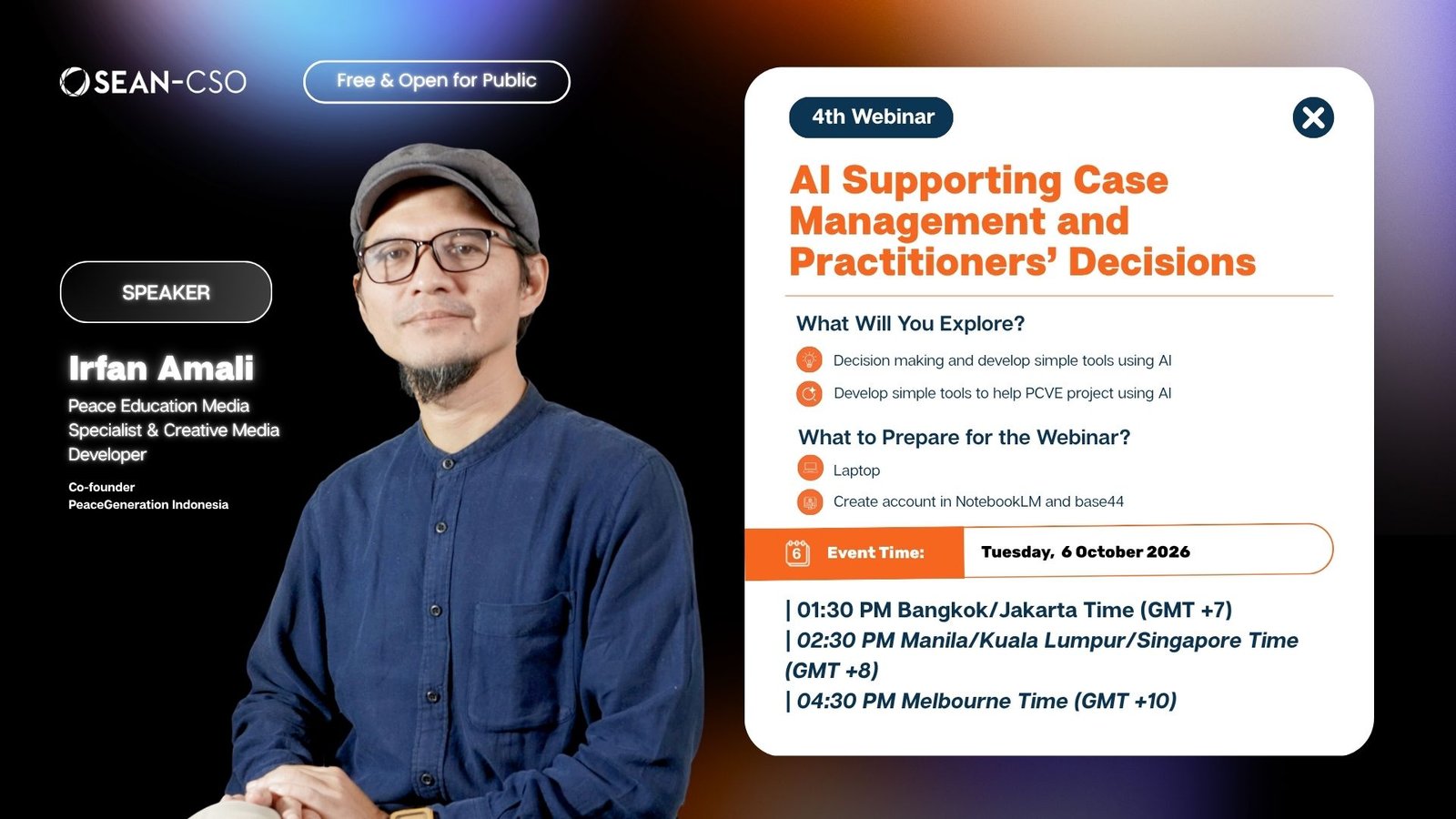
The fourth webinar of the SEAN-CSO 2026 webinar series will bring these ideas into practice through two connected areas, beginning with decision-making and developing simple tools using AI, where participants will explore how AI can support practitioners in working with information, thinking through decisions, and developing simple solutions for practical needs.
The session will also explore developing simple tools to help PCVE projects using AI, giving participants an opportunity to consider how AI can help turn specific project needs into simple tools that can support their work.
To make the session more practical, participants are encouraged to prepare a laptop and create accounts on NotebookLM and Base44 before joining the webinar, so they can follow along as the session moves from discussing possibilities to exploring how these tools can be applied in practice.
Following our discussions on AI-supported counter-narratives and AI-assisted detection, the fourth webinar takes us one step further by looking at how practitioners themselves can use AI to work with information, support decisions, and develop simple tools for their own PCVE projects. Rather than focusing only on what AI can analyse, the session will explore how practitioners can connect AI capabilities with the practical challenges they encounter in their work and use the technology to develop solutions that respond to those needs.
Webinar Details
AI Supporting Case Management and Practitioners’ Decisions
Tuesday, 06 October 2026
01:30 PM GMT+7 (Bangkok/Jakarta Time)
02:30 PM GMT+8 (Manila/Kuala Lumpur/Singapore Time)
04:30 PM GMT+10 (Melbourne Time)
Online via Zoom
Speaker — Irfan Amali
Irfan Amali is the Co-founder of PeaceGeneration Indonesia and a Peace Education Media Specialist & Creative Media Developer, focusing on creative approaches to peace education and prevention.
What to Prepare
Participants are encouraged to bring a laptop and create accounts on NotebookLM and Base44 before the webinar so they can engage with the practical elements of the session.
Join the Fourth Webinar!
