
In the second webinar of the SEAN-CSO 2026 learning series, we explored how AI can support counter-narrative work beyond simply creating content. The discussion moved from understanding audiences and narratives to exploring how AI can support research, develop different approaches, and measure responses. One idea that remained central throughout the session is that AI can support the process, but human judgement is still needed to understand context and decide what to do next.
That conversation naturally leads to another part of the P/CVE process. Before we can think about how to respond to a narrative, we first need to understand what that narrative looks like and how it can be identified. This is where AI-assisted detection comes in, but getting an AI system to recognise an extremist narrative involves much more than feeding content into a model.
It Starts With Defining the Narrative
Extremist narratives do not always appear through obvious keywords or explicit statements. They can be expressed through particular ways of framing an issue, coded language, references, or connections between ideas that only become meaningful when viewed in context. The same word or phrase can also mean something different depending on who is using it, where it appears, and what surrounds it.
For researchers, this creates an important starting point → What exactly should the AI be looking for? Developing clear definitions and annotation frameworks helps turn complex concepts into categories that can be consistently applied to real-world content. Without this foundation, even a technically sophisticated classifier may end up learning from unclear or inconsistent examples.
The Humans Behind the Data
Once researchers have established what they want to identify, someone still has to apply those definitions to actual content. This is where annotators become an important part of the process. Annotators review examples and assign labels according to an established framework, helping create the datasets used to train and evaluate AI classifiers. Their work may sound straightforward, but applying a framework consistently can become difficult when content involves irony, coded language, cultural references, or different interpretations of the same message.
This is why recruiting, training, and validating annotators matters. Researchers need to understand whether people are applying the framework consistently and where disagreements may arise. These human decisions eventually become part of the data that AI learns from, meaning the people behind the dataset can influence what the model is ultimately able to recognise.
A Classification Is Only the Beginning
Once the framework and data are in place, AI can help researchers process much larger amounts of content and identify patterns that would be difficult to examine manually. A classifier can sort and flag content based on what it has learned, giving researchers another way to explore large and complex datasets, but a classification is not necessarily an explanation.
An AI model can produce a result without fully understanding the context behind the content. It may struggle with language, ambiguity, cultural references, or narratives that do not fit neatly into the categories it has learned. Its classifications may therefore require further examination before researchers can draw meaningful conclusions.
Interpreting classifier outputs becomes an important part of the work. Researchers need to consider what the model identifies, what it may have missed, and how its limitations affect the results. The question is not only whether AI can detect a particular narrative, but also how researchers can understand and responsibly use what the model tells them.
Meet the Tackling Hate Lab
These questions are closely connected to the work of the Tackling Hate Lab at Deakin University, which brings together social science, psychology, data science, and AI to study hate, prejudice, extremist violence, and other forms of ideology- and prejudice-driven behaviour.
Its multidisciplinary approach shows why AI-assisted detection cannot be separated from the research around it. Computational tools can help researchers examine patterns across large datasets, while social science and human judgement provide the definitions, context, and interpretation needed to make sense of those patterns.
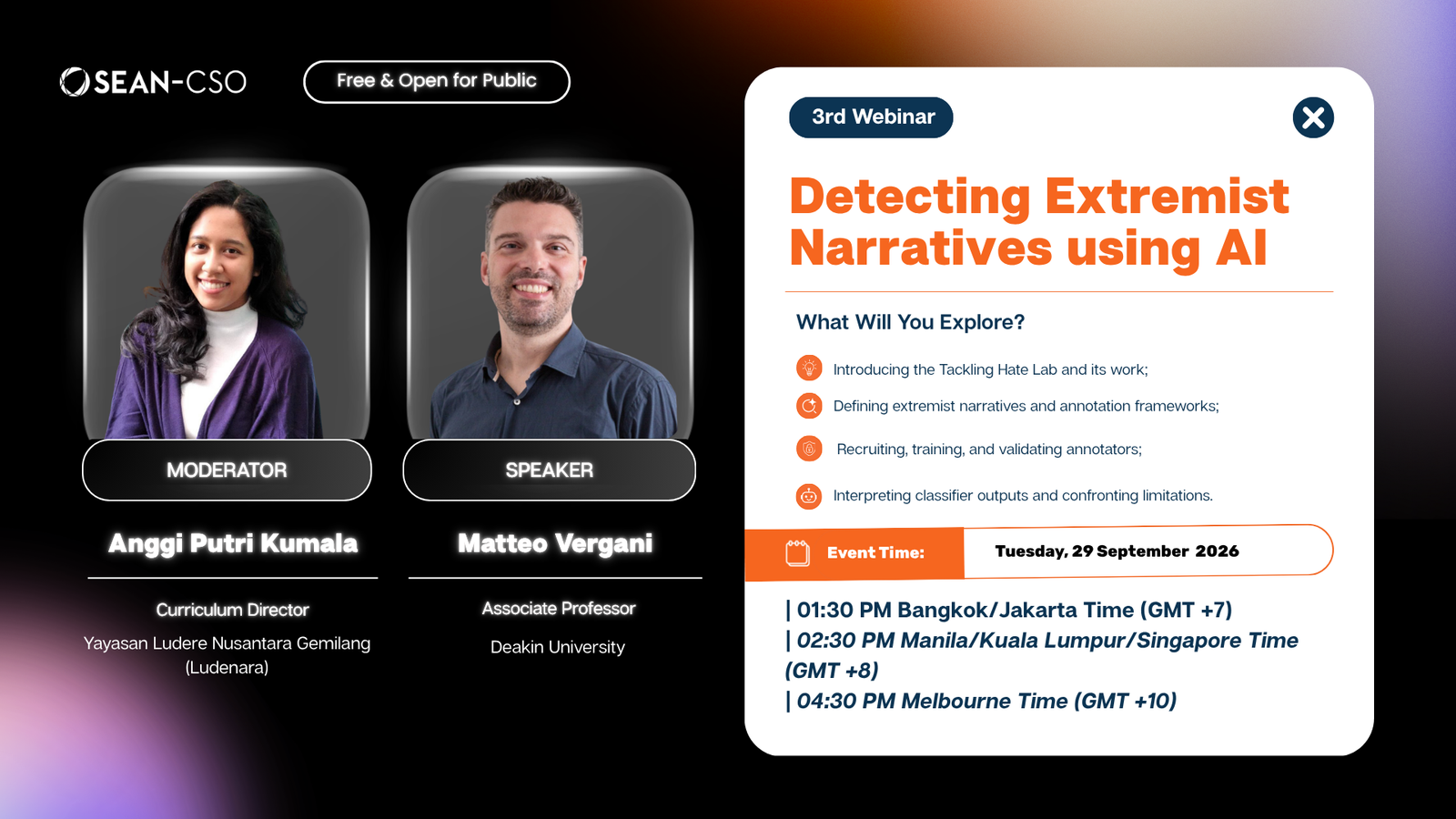
In the upcoming webinar, Associate Professor Matteo Vergani, Director of the Tackling Hate Lab, will take us through this process, from defining the problem and preparing the data to interpreting classifier outputs and confronting the limitations of the technology.
What Will We Explore?
The third webinar of the SEAN-CSO 2026 learning series, Detecting Extremist Narratives Using AI, will take us through four connected areas:
- Introducing the Tackling Hate Lab and Our Work → An introduction to the Lab, its research, and its approach to studying hate and extremist narratives.
- Defining Extremist Narratives and Annotation Frameworks → How researchers define the narratives they want to study and develop frameworks for identifying them.
- Recruiting, Training and Validating Annotators → How human decisions become part of the data used to train and evaluate AI classifiers.
- Interpreting Classifier Outputs and Confronting Limitations → How researchers understand AI classifications and account for the limitations behind those results.
Following our previous discussion on Developing Counter-Narratives with AI, the third webinar moves one step earlier in the process, from thinking about how we respond to narratives to exploring how we can identify and study them in the first place.
Webinar Details
Detecting Extremist Narratives Using AI
Tuesday, 29 September 2026
01:30 PM GMT+7 (Bangkok/Jakarta Time)
02:30 PM GMT+8 (Manila/Kuala Lumpur/Singapore Time)
04:30 PM GMT+10 (Melbourne Time)
Online via Zoom
Speaker — Matteo Vergani
Associate Professor at Deakin University and Director of the Tackling Hate Lab.
Moderator — Aughya Shandriasti
Curriculum Director at Yayasan Ludere Nusantara Gemilang (Ludenara).
Join the third webinar! https://seancso.org/registerseancso2026

